I Completed the Tesla Robotaxi Triangle in 24 Hours
In 24 hours, I rode Tesla Robotaxi across Austin, Houston, and Dallas — the Robotaxi Triangle — with three different people, gaining a firsthand look at where autonomous transportation in Texas really stands today.
Austin. Houston. Dallas.
Three cities. Three Tesla Robotaxi experiences. One 24-hour run through what is now being termed as the Robotaxi Triangle.
For years, I have been following and feeling the progress of Full Self-Driving (FSD). It seems to exist in a kind of limbo. Online, there is a never-ending debate about whether FSD is already near completion, overhyped, dangerous, impressive, or all of the above. I chose to find out for myself and experience Tesla Robotaxi in as many settings as possible.
So that became the goal.
Austin. Houston. Dallas.
All within 24 hours.
After checking out Austin, I continued on my adventure and headed to Houston, then on to Dallas and back, all in the span of 24 hours. Along the way, I was able to mix in some great friends, be on an amazing podcast, take plenty of photos, and really start to see the early makings of a complete autonomous transportation network.
Why I Wanted to Do This
I have followed the story of Tesla's Full Self-Driving (FSD) Beta technology for years. I own a Tesla Model 3, am very interested in the advent of AI generally, and have read extensively about FSD technology as well as the broader landscape of both established companies and startups such as Waymo, Zoox, and AVride developing their own solutions for autonomously transporting humans.
From the outside, Robotaxi is something that can be discussed and argued about through videos, blog posts, comments, and comparisons with Waymo, Zoox, and AVride. However, when there is no human controlling the vehicle, you start to pay attention to things that normally would go unnoticed when you are driving.
When there is no one at the wheel, you pay attention to things you normally ignore.
How does it pull up?
How does it handle weird traffic?
Does it feel confident?
Does it feel cautious?
Does it make you overlook the autonomous technology after a few minutes? You are able to watch all of the actions that the Robotaxi makes while it is driving down the road, but after a while, you do not pay attention to them anymore.
That is what I wanted to find out.
My reason for doing this also rested in part with wanting to experience Robotaxi with several different people while traveling across the three cities. This would allow me to learn more about each of the cities where the technology is being put to work and gain insight into how different people reacted while being passengers in a fully autonomous vehicle. In Austin, I met up with Gail Alfar; in Houston, with Sheri; and in Dallas, with Spencer.
Stop One: Austin with Gail Alfar
Austin was the natural place to start.
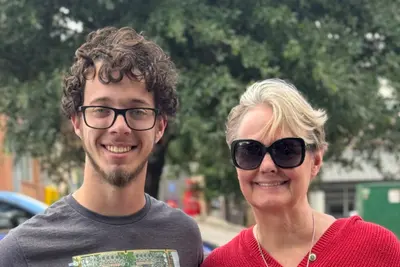
Tesla's Robotaxi story in Texas began in Austin. That is why I started my Robotaxi road trip here. I met up with Gail Alfar in Austin for her podcast. Gail is an evangelist for all things Tesla, especially around the Giga Texas facility in Austin, as well as the ever-growing Tesla community in Austin. It seemed to be the perfect place to kick off the road trip, and it was a lot of fun to record her podcast.
There were many Tesla autonomous vehicles that I saw around the city, as well as others like Zoox and Waymo. It is clear to me that there is a lot of work going on around Austin to further develop transportation of the future and that there are many players in the game. Tesla, however, is the one that started Robotaxi in Texas here in Austin, and it is what I had come to see and learn about first.
As I walked through the streets of Austin, I saw a number of AVs on the road. I'm not just talking about Tesla Robotaxis. I saw several Zoox vehicles and a couple of Waymos around as well. It seems like Austin is one of the hotbeds for the development of autonomous vehicles and one of the testing grounds for the future of how people will be able to get from point A to point B.
Then we did an unsupervised Tesla Robotaxi ride.
This was the first real stop on my "triangle" of autonomous testing.
It's a huge difference watching someone else's videos online versus actually experiencing a Tesla Robotaxi drive yourself. For starters, the fact that there is an empty driver's seat really changes your perception of what it would be like to take a ride in a Robotaxi.
But after a few minutes, something interesting happens.
It starts to feel normal.
Again, I didn't expect to find the technology to be this impressive this quickly. But in reality, after a few minutes on the road, I stopped paying attention to the fact that the car was driving itself. It became normal. The car turned where it needed to, braked when it needed to, moved to the left lane when it was faster, and stopped at the traffic light for a few seconds.
We headed back to my car after that to record the podcast while the experiences were still fresh in my mind. After recording the podcast, I took a number of additional Robotaxi rides throughout Austin, then packed up and headed off to Houston.
The Tesla Robotaxi energy in Austin is still strong. The podcast recording with Gail helped kick off the next leg of my trip out to Houston. The additional Tesla Robotaxi trips I took in Austin helped remind me just how many autonomous vehicles were operating there as well.
Stop Two: Houston with Sheri
After Austin, I headed to Houston.
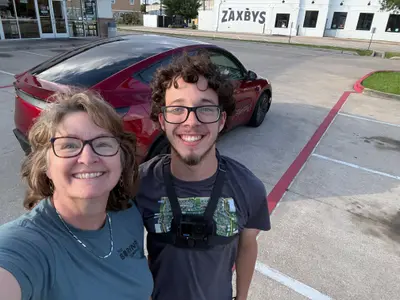
In Houston, I met up with Sheri, @sdlocke1 on X. She is a great friend of mine, and we met at Chattanooga Charge, where I had spoken. We had chatted previously after she reached out with a photo from the event. It was great to meet her in person and try Robotaxi in Houston.
I like the Tesla community because a random connection made while speaking at Chattanooga Charge led to meeting up in another city to test and experience Robotaxi together.
Houston felt different from Austin right away.
Austin felt like the original hub for Tesla's development of Robotaxi, while Houston felt like a beta test for handling the scale of a very large city for transporting people. As previously mentioned, Houston is a very big and very spread-out city. There are many places where Tesla could potentially "fake" the ability of the Robotaxi system to scale, but sooner or later, you run into physical limits. It is at those limits where Robotaxi is going to have to actually function in reality in order to be a viable part of a transportation network for a large number of people.
Sheri and I were able to test out some Tesla Robotaxi rides in Houston, and I was able to take some photos of the new production Tesla Cybercabs that have yet to release.
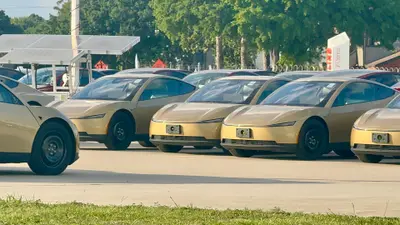
It was great to experience current Robotaxi and the planned, more Robotaxi-like transportation in the same trip.
You also see the limits of the current system in Houston, though. Robotaxi is very real right now, but it is also very early right now. The availability of the service, the boundaries of the service, and the timing of the service all still matter quite a bit. You cannot treat it like you treat Uber, for example. You have to have a plan in place to use the service and take advantage of it.
That does not make it less impressive. It makes it more interesting.
The technology is finally here and being put to use, but these are still the early days of building a network around it.
Stop Three: Dallas with Spencer
The next stop was Dallas to complete the circle of three events.
After Houston, the journey was really for the sake of completing Austin, Houston, and Dallas in 24 hours. Dallas was the destination for the last trip.
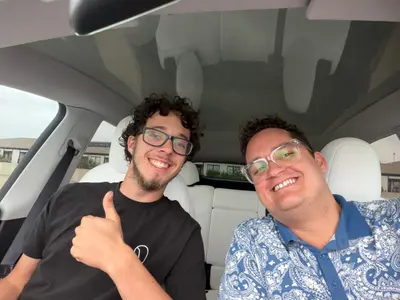
Once I arrived in Dallas, I met up with Spencer, @scotsrule08, for a couple of AV rides: Tesla Robotaxi and a trial of the AVride service. Confusing naming, like come on guys.
Dallas was the final city to test AVs and was a great place to end the "triangle." In Houston, I tested Tesla's version of Robotaxi, but in Dallas, I got to test that same technology as well as AVride. Other companies, such as AVride, have different hardware, such as cameras and sensors, different vehicles, and completely different methodologies to reach Full Self-Driving or autonomy. Tesla is just one of the many companies trying to reach that goal. Dallas allowed me to get a glimpse into the online comparison that many people think exists between companies like Waymo and Tesla while actually seeing two different AVs and experiencing them in a personal way.
Trying both in Dallas made the broader AV race feel more real.
You generally read online about how one company is attempting to solve Full Self-Driving (FSD) autonomously versus another, such as Tesla versus Waymo and their use of cameras versus LiDAR and sensors. But there is so much more to this issue than just reading and comparing.
How easy was it to get the ride?
How did the pickup feel?
Did the car seem natural in traffic?
Did it hesitate?
Did it make passengers feel comfortable?
Was the experience more of a demonstration of the technology, or a ride?
The above points were what made the comparisons between Tesla's Robotaxi and AVride important to note.
Dallas was the endpoint of the Robotaxi Triangle because there, I was able to experience Robotaxi in three different Texas cities with three different people under three different circumstances. Austin was the origin of the Robotaxi travels, Houston tested the Robotaxi, and Dallas was the finish line, comparing notes on the experience.
So when the last ride in Dallas came to an end, I knew that the Robotaxi Triangle tour had come to a close.
Austin, Houston, Dallas, all within 24 hours.
What Stood Out
The biggest thing that struck me was how quickly the actual rides started to feel normal.
That sounds simple, but it really isn't.
At first, the ride can be a bit surreal. You are picking yourself up in a car that is driving itself through real traffic with no human at the wheel. As the car makes its way down the road, the driver, or rather the car, makes all of the turns and decisions along the way.
But then the feeling changes.
You start to carry on a conversation with someone on the phone or with someone else in the car. You look out the window at the buildings passing by. You take out your phone and start to check your messages. The vehicle is handling the route, so you don't have to pay attention to every turn of the wheel. In fact, you stop paying attention to the wheel entirely, and the car just becomes your ride.
That is when the technology feels the most real.
Not when the AV is doing something fancy, but rather when the AV becomes so second nature that you can trust it to behave itself in a few minutes of unattended travel.
In the history of AVs, much of the testing was concentrated in California. However, Texas is rapidly becoming another hub for development and proving grounds for a variety of autonomous solutions. We saw AVs from Tesla, Waymo, Zoox, AVride, and more roaming around Austin and the roads connecting to the surrounding cities and other hubs, including the many businesses now concentrated in Houston. The fact that there are so many players testing in one location makes the coming few years for the industry quite exciting and highlights just how serious Tesla must be with its approach to offering up a Robotaxi-like service for its customers.
That makes Tesla's progress more interesting, not less.
This is not to say that it is somehow less impressive that Tesla would launch Robotaxi in an empty market. Instead, it underscores the fact that the company is entering a space already fully populated by a large array of vehicles, all of which are already very actively engaged in intense levels of testing, as well as the scaling that implies in terms of building out large networks of vehicles in a wide number of locations.
What Still Feels Early
My trip around Austin watching others take Robotaxi rides was equally impressive and highlighted how early Robotaxi is for consumer-facing transportation.
A lot of focus has been placed upon the technology already in place in terms of working Robotaxi service in certain geographies, but such a service is not yet truly widespread. Consumers will still have to pay close attention to where Robotaxi service is offered, where it is not, and times when service is not available in order to have the best Robotaxi customer experience.
That is the difference between a working technology and a fully mature transportation system.
Mature Robotaxi service would be trivial. The service would be so much a part of the fabric of your life that you would probably only realize it is there when it is gone. Open up the app. Press the button. You go.
Tesla is not fully there yet.
I made a mistake in my previous post when I said that it would be "insane" to have ridden Robotaxi in three cities in one 24-hour period not so long ago. Today, it's a reality.
The gap now is not whether or not there is a working technology behind Robotaxi; there is.
How fast can Tesla turn Robotaxi into a reliable, available, safe, and normal transport network?
That's the big unknown.
Tesla's Bigger Bet
Tesla's Robotaxi strategy has always been different from most of the industry.
All vehicles run with cameras and neural networks to autonomously steer. They run on the existing Tesla vehicle platforms. Every improvement to the software will improve the whole network. Each vehicle platform can then be used for more autonomy. Each city can then more easily be expanded to for Robotaxi services.
That is what makes Robotaxi so important to Tesla.
If Tesla makes Robotaxi work, then the economics of transportation are completely changed. The potential to improve every aspect of the system via software improvements. The ability to use every vehicle platform for autonomy. The opportunity to go into every city in the world.
But there is a high standard to reach.
Robotaxi must be impressive every time, and hence, the company is placing a very high bar for it to perform safely, consistently, repeatably, and even in a dull manner. It has to go through a variety of "normal" roads and sometimes very strange ones, and handle all kinds of edge cases: from normal behavior to very abnormal; from calm to crazy drivers; from easy-to-pick-up passengers to very confusing pickups; from daytime to nighttime driving. It must perform well with a lot of passengers and in various environments.
It does not matter how long Tesla has worked on Robotaxi. Robotaxi needs to work safely, normally, and predictably for every trip.
People will not appreciate the complexity of the task of autonomy. They simply want the ride to work.
Our observations and insights from learning about Robotaxi by using Robotaxi as the product under test are far superior to any generated by reading a spec sheet of anticipated features in development of the product.
The Human Side of the Trip
The technology was the reason for the road trip, but the people made the trip memorable.
Gail and I associated our excellent experience with Tesla's Robotaxi in Austin with the rest of the Tesla story and with the lively community of Tesla fans that we have encountered on our journey.
In Houston, I used Robotaxi to connect with Sheri, whom I had met at Chattanooga Charge. We went on several rides, and then I continued on to Dallas for more testing of Tesla Robotaxi compared to AVride.
In Dallas, Spencer and I got to compare Tesla Robotaxi with AVride and talk through what these different approaches feel like as actual passenger experiences.
That is what made the triangle more than a transportation experiment.
The Robotaxi Triangle was a tour of communities experiencing the major technology shift of autonomous transportation. Each person I met along the way had a reason for caring about the topic of autonomy. Some people care about Tesla. Some care about AI in general. Some simply care about transportation in general. Then there are people who are documenting the transition as it occurs. That is what the Robotaxi Triangle was for me.
For me, it was all of that.
My Takeaway
After completing the Robotaxi Triangle, I have solidified in my mind that autonomous ride-hailing is real. However, there is more work to be done.
Tesla Robotaxi is not just a concept, talk by Elon on a conference, or fancy slides at a presentation. It is a real technology to provide autonomous rides as a service (AaaS). I used it to travel in three cities in the state of Texas in a 24-hour period of time.
That matters.
To my knowledge, and to David Moss's and Spencer's, only two people had done this before me. David was first, Spencer was second, and I was the third person outside of Tesla to complete the Robotaxi Triangle.
The service areas for Robotaxi are currently very limited for autonomous travel, the availability of cars for picking up passengers is still a major factor, and the reliability for becoming a "go-to" app like Uber or Lyft is not there yet.
But early does not mean fake.
Early means unfinished.
And that is probably the best way to describe where Robotaxi is right now. It is real, impressive, limited, and still developing quickly.
The Robotaxi Triangle started out as a clever idea: to travel from Austin to Dallas, through Houston, all within 24 hours. By the end of the trip, it had become something much more. It had become a snapshot in time of what it's like to use Tesla Robotaxi services in Texas.
This is what Tesla Robotaxi felt like in Texas at this moment.
Not someday.
Now.